

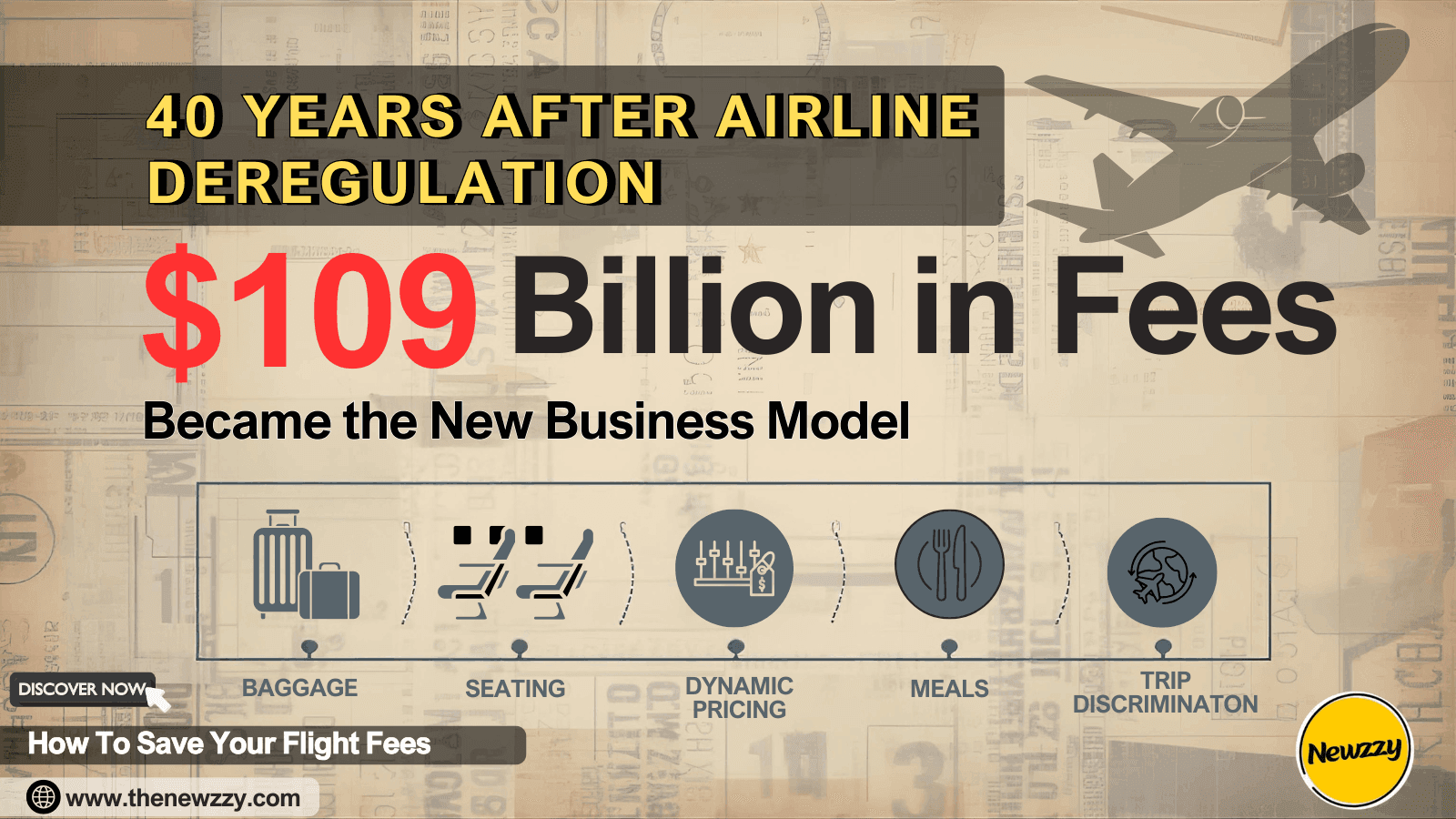
Airline Deregulation act: Days of the comprehensive plane ticket no longer exist. What started in 1978 as a risky show of democratizing flying has become a high stakes game of financial hide-and-seek. Currently, the airline companies rake in enormous amounts of money selling the things that were once promised.
Table of Contents
2026 Domestic Airline Fee Comparison Table
Note: Fees are per one-way segment. “Prepaid” refers to paying online at least 24 hours before departure.
| Airline | 1st Checked Bag (Prepaid / Airport) | Carry-on Bag Fee | Seat Selection (Advance) |
| American | $35 / $40 | FREE | $15 – $60 |
| Delta | $35 / $40 | FREE | $0 – $60* |
| United | $35 / $40 | $0 (No Carry-on for Basic Economy**) | $15 – $75 |
| Southwest* | $35 / $45 | FREE | $15 – $150*** |
| JetBlue | $35 – $50 | $0 (No Carry-on for Blue Basic**) | $15 – $60 |
- * Delta frequently offers seat assignment in the Main Cabin; the charges are available on the Basic Economy mostly. ** United and JetBlue “Basic” fares have no option to use an overhead bin; they get the bag fee with an extra handling fee of approximately 25 dollars when brought to the gate. The additional legroom and assigned seating at Southwest actually starts January 27, 2026.
The vow of 1978: Operation Stop the Sky Police
The Civil Aeronautics Board (CAB) held on to the skies with iron fist before 1978. This was a federal agency that controlled the very routes that airlines could use, the airline prices or fares they could set and when they could fly.
The Gilded Age of Unfair Means to an Unjust End
The airlines operated as utility under the CAB. There was practically no competition since fares were determined by the government. As people were provided with luxury services, they were charged exorbitant prices in order to enjoy the service. It was glacial innovation. Take the case of World Airways that took six years to be approved a route but was rejected. The continuity of Continental Airlines lobbying the government in eight years to fly between Denver and San Diego.
A Bipartisan Revolution
In the mid-1970s the oil crisis of the 1973 and high inflation rendered the regulated system unsustainable. Economists said that regulation defended the inefficientness to the detriment of the consumer. Economist Alfred E. Kahn was brought in by President Jimmy Carter to dissolve the CAB. The legislation was almost unanimously passed with the Deregulation Act going through the Senate by a unanimous vote of 83-9 and the House going by a majority of 363-8. It was all about low fares, competition, and industry that was enabled by the market.
The Findings: Low Fares and Fortress Hubs
Deregulation was very effective in attaining its main objective; it has rendered flying a middle-income earner. But it also brought about a savage survival-of-the-fittest scenario that changed the industry forever.
The Airline Fare Crash
Flying became more of a commodity than a luxury. By the year 1994, the average mile fare was reduced by 9 percent compared to 1979. The price of fares went down by almost thirty percent when inflation is factored out between 1976 and1990.
- 1974: A ticket between New York and Los Angeles was equivalent to 1442.
- 2010: That same route dropped to $268.
The Consolidation Wave
The open market became fatal to a number of legendary airlines. Eight big airlines such as Pan Am, TWA and Eastern became bankrupt between 1978 and 2001. More than 100 smaller carriers went out of business. The result of this turmoil was the birth of a so called Hub-and-Spoke system and the emergence of so called Fortress Hubs, one airline being dominant in a given city. In the U.S. market, only four large airlines dominate 80 percent of it today.
The Birth of Unbundling
Airlines were forced to seek survival in the price wars by considering European low-cost airlines such as Ryanair. They started to strip the ticket bare, to unstrip the ticket, and charge everything off. Northwest became the first to charge seat selection in 2006 and this trend became a general rule in the industry.
The Airline Fee Economy | The Billion-Dollar Optional Survey
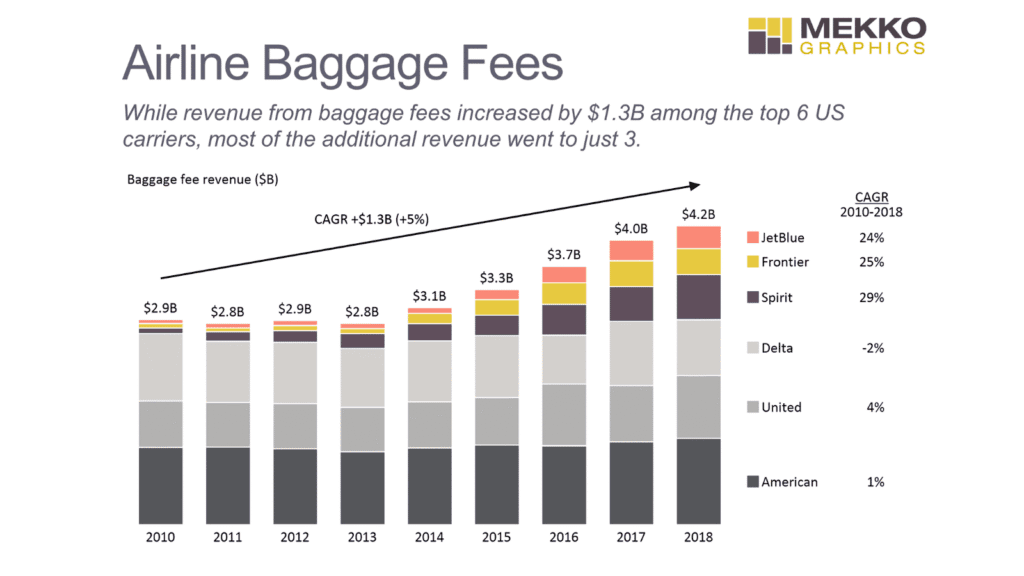
Ticket sales are no longer the only important thing in the airlines. They have switched to the center of ancillary revenue – the fees charged on baggage, seats, and the statuses of priority.
Revenue Growth Of Airlines
This means that the top 10 global airlines produced ancillary revenue amounting to $54.1 billion in the year 2023. Five largest airlines in the United States earned a total of 12 billion dollars in seat and legroom charges between 2018-2023 alone.
| Airline | Extra Legroom Fee Range |
| United | Up to $319 |
| Spirit | Up to $299 |
| Delta/American | $140 – $264 |
A psychology of Drip pricing in Airline Fare
Drip pricing is used to maximize the conversion by airlines. They are promoting a 99-base fare that grounds the emotional attachment of the consumer. The baggage and seat prices are not shown early enough in the flight booking. East Carolina University research indicates that once a customer has picked a seat, whether a free one or not, they pass an otherwise mental barrier that reduces their odds of forfeiting the purchase despite the overall cost going beyond $200.
Airline Deregulation 2.0: The 2025-2026 Rollbacks
Lost Protections
By 2026 the pendulum of regulation has swung towards the airlines again. There is a systematic destruction of a number of Biden-era consumer protections under the Trump administration.
The rule that companies would have to pay out 200-775 dollars in cash rewards to customers because of the delays that could not be controlled was canceled by the DOT in November 2025. This rule was focused on imitating European standards but was abandoned in not coinciding with the contemporary priorities. Also, the administration reduced the outstanding balance of the fine amounting to 11 million in the case of Southwest due to its 2022 operational meltdown.
The A4A Wishlist
To be eliminated is being lobbied by the industry trade group Airlines for America (A4A) which represents the big three of Delta, United and American, the giants of the industry.
Automatic refund rules
- “All-in” pricing transparency.
- SEAT (guarantee of children sitting with their parents free).
- Published consumer complaint boards.
EU261 Model: International Comparison
As the U.S regulations are laxed, the European union stands out as the standard of passenger rights known as EU261.
Mandatory Compensation
EU law provides three-hour time limit cash compensation fees of between 275 and 660. Food and accommodation are to be offered to airlines during the wait. This law is applicable when getting off the EU flights, no matter what carrier airlines might have.
The Profitability Myth
American airlines tend to argue that this would drive fares into the air. Nevertheless, the European low-cost airlines such as EasyJet are very profitable and they are not in violation of these regulations. Its major difference is that the European policy is based on consumer rights rather than carrier convenience.
The Hidden Airline Charges
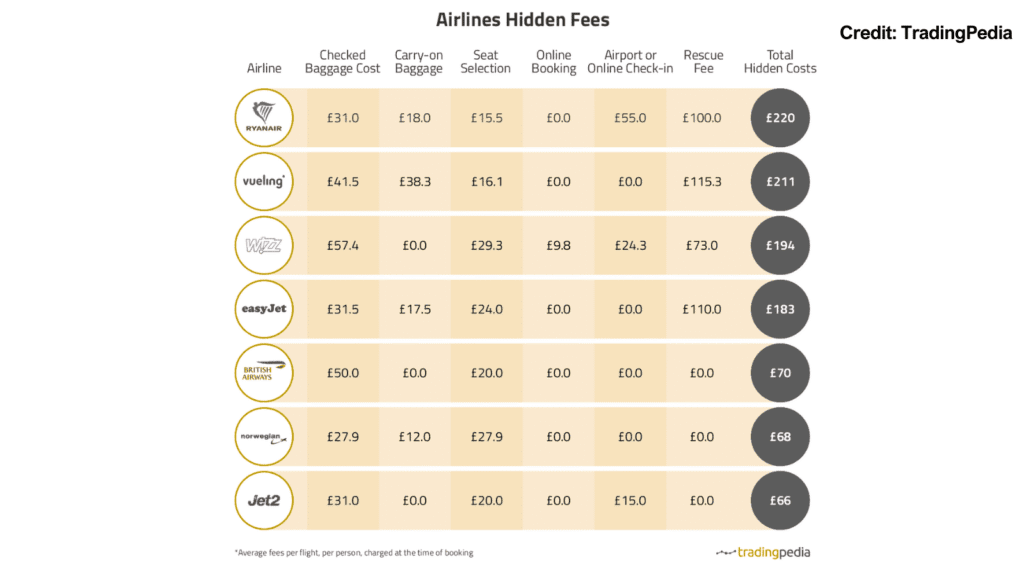
Even the base fare has become a financial illusion. The price that is advertised is often less than half the billing on which a family of four will end.
The Math of a “$99” Flight
- Advertised Fare: $99 each way.
- Checked Bag: $40 each way.
- Seat Selection: $30 each way.
- Round Trip: $338 (241 percent higher than the base price shown in advertisement).
With a couple of four people the marketed price of 396 in ticket form can easily shoot up to 1350 dollars when simple needs like sitting together and transportation of luggage are added.
Guide to Avoid Hidden Flight Fees
The strategy to travel in the future of 2026 makes it necessary to be tactical. Consumers will need to be their own guardians in order not to pay unwarranted points.
Strategic Booking
- Compare Fares to Total-Cost Calculators: It is advisable always to compare the end checkout price and not the first available search price.
- Use leverage cards: Airline co-branded credit cards (such as Chase or Amex) can usually cover their own adoption by waiving the mandatory baggage fees.
- Loyalty Programs: The low level of status may even include being able to choose seats freely or be given priority boarding.
At the Airport
- Personal Item Maximization: Buy bags that have specific sizes of under-seat storage that will fit exactly to avoid carrier charges.
- Record All Records: In case of a flight delay, capture the screenshots of the status page and the airport gates announcements. Response to customers faster through the social media than in the queue at the airport.
- Screenshot Policies: Fees change regularly within the airlines. An example of this is the presence of a screenshot of the policy when you have made your booking, which guards you against price increases in the middle of your booking.
The Future: The Next Airline Deregulation
According to the prognosis of 2026-2028, the airline profitability will be in the Golden Age, and the consumer transparency will not be easy to understand.
- Dynamic Pricing: AI mainly will be even more dynamic and will charge you according to your past search history and a perceived sense of urgency.
- State-Level Pushback: States, such as California and New York, should be expected to seek their own consumer protection protection as federal controls get weaker.
- The International Rift: This will see the development of a widening gap in the level of services delivered by domestic flights within the United States as compared to the international consumer protection treaties.
One of the questions posed by justice Stephen Breyer was whether anybody would want to go back to the good old days of the high and controlled prices. In 2026, the answer is complex: we have the cheapness that we demanded, only to spend it a bag at a time on buying a bag and a bag.
The Southwest Seismic Shift (Effective Jan 27, 2026)
When you book an air travel today, you are witnessing the end of the times. This week, Southwest has fully switched to the industry-standard model:
- Seats: No longer will there be boarding group sprints. This however comes at the expense of having the most desirable seats being a premium.
- The Bags Fly Free: Sunset: It is now $35 to buy the first bag after they changed their policy in May 2025.
- Extra Legroom: Choice Extra is the first leadership that Southwest is charging upfront seating, and that can fetch as high as $150 in long-haul domestic flights.
How “Drip Pricing” Catches You
The Drip Pricing is a psychological approach which airlines employ. They tempt you with a low-cost fare (which can be lower than 100 dollars) and impose fees as you go along.
The Anchor: $99 is seen and an emotional promotion is made to the trip.
- Check: You are questioned concerning bags. You end up paying 35 due to the necessity to have your luggage.
- The “Scare”: There is the presentation of a seat map where there is Limited Availability. You spend 20 dollars to be sure that you are not sitting in the middle.
- The Conclusion: When you get to the place where you pay the money, it is no longer the 99 dollar flight but the 175 and above. With the time you have spent on the booking already, you have a 68 percent higher chance of making the purchase as opposed to the time you had viewed 175 upfront.
Pro-Tips for 2026 Travelers
The 24 Hour Rule: Nearly every carrier (except low-cost carriers such as Frontier/Spirit) is offering some kind of incentive to pre-pay bags online, with a discount of 5 dollars.
Simple Math Economy: The savings of a Basic Economy ticket (typically, 30) on United and JetBlue is frequently lower than the price of the carry-on bag you will have to buy because you can not have a carry-on bag. The all in price must be computed at all times before making a purchase.
