

712 cases detected around the world regarding AI Failures in Law and hallucinated citations.All came to a halt in July 2025 with a case tried by lawyer Christopher Kachouroff, which has become a nightmare of the contemporary judicial system. Kachouroff had a brief on behalf of MyPillow CEO Mike Lindell that seemed to be a normal advocacy item. Nevertheless, Judge Nina Y. Wang quickly found out that at least twenty-six mistakes had found their way into the document.
This accident is not an exception but a part of a colossal increase of technological failures. We are now following a wave of AI hallucination which is a situation whereby AI goes on its own, and confidently fabricates false information, worldwide.
- 712 cases detected around the world regarding hallucinated citations.
- An astonishing 324 cases established in the U.S. courts.
- This has sanctioned 128 lawyers and 2 judges.
- Those pro se litigants 189 people representing themselves without an attorney fell into the same trap.
Why AI Mistakes in Law Matters For You
- Precision is not a choice: One fabricated reference will result in an inquiry of professional malpractice.
- Cost Efficiency: You are saved in time when the output is right. It is very likely that it can take more time to fix AI errors than traditional research.
- Ethical Duty: Ethics rules that guide the conduct of lawyers are called ethical duty, and have competence as one of its components, now including technology knowledge.
| Legal Term Used in This Article | Simple Definition |
|---|---|
| LLM | The “engine” that predicts the next word in a sentence to generate text. |
| CLE | Continuing Legal Education; the mandatory training lawyers must take to stay licensed. |
| RAG | A safety net that forces AI to look at real books before speaking. |
| AI Hallucination | A digital “dream” presented as a factual reality. |
The case that Kachouroff had done with ChatGPT to research led to submissions of citations of nonexistent judicial decisions. After being questioned at first, the attorney did not admit to having used AI assistance. Only by questioning the defendant by the court directly did the truth come out. As court documents indicate, studies show that judge Wang determined during the investigation that the legal team was not telling the truth. This led to a fine of 3, 000 dollars per lawyer and humiliation before the public that entered newspapers of all the states.
The number of these errors is increasing more rapidly. Approximately twice a week, around 2025 there were two cases per week in the legal system; around mid 2025, the rate of cases was about three cases per day. Since the month of September 2024, six federal filings have included faked actions within Arizona. It is not merely an issue of a handful of irresponsible lawyers; it is a forensic inquiry of whether or not legal artificial intelligence can actually provide the accuracy it claims to.
Table of Contents
Real Court Cases Where Lawyer Produced Faulty Citation Due to AI
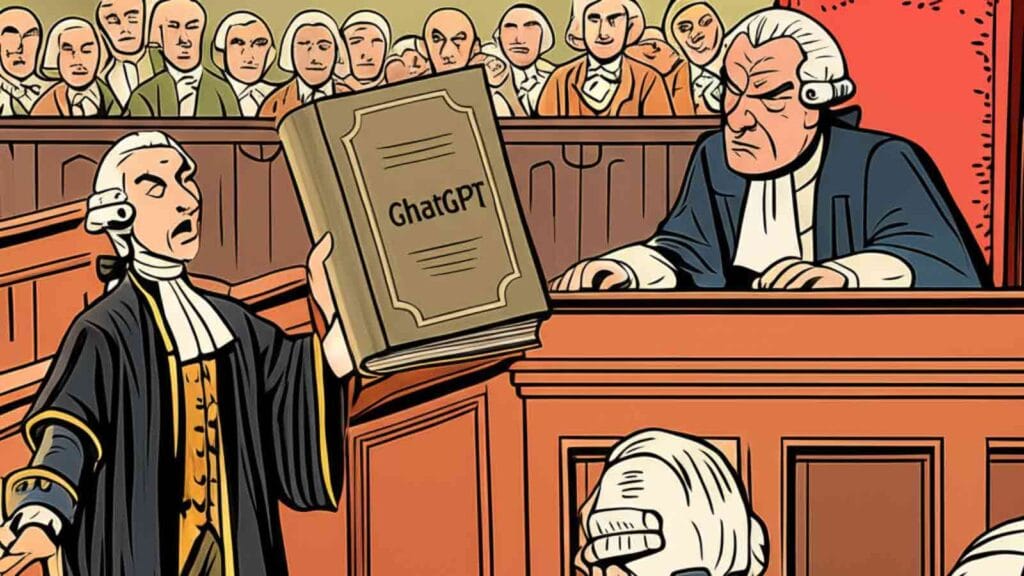
- Coomer v. Lindell/MyPillow Sanction: Sanctions against Lindell. Lindell, No. 1:22-cv-01129-NYW (D. Colo., July 7, 2025). Attorneys Christopher Kachouroff and Jennifer DeMaster were order to pay fines of $3,000 to judge Nina Y. Wang after producing almost 30 faulty citations with the aid of AI.
- According to the case 31,100: Central District of California (May 2025): The $31,100: Collective Debacle. Law firms K&L Gates and Ellis George LLPwere approved by Special Master Michael Wilner of a brief full of nine hallucinated citations. The order indicated the horrific future of such errors going into the records of official judicial proceedings.
- Morgan and Morgan / Walmart Case: U.S. District Court of the District of Wyoming (2025). Attorneys, Michael Morgan and Taly Goody, were sanctioned by judge Kelly Rankin to present eight non-existent personal injury cases against Walmart.
- The compassionate Admonishment: Hall v. No. 2:24-cv-08630-JMW (E.D.N.Y, August 7, 2025). To Magistrate Judge James M. Wicks, who wanted Suryia Rahman to pay fines, attorney Suryia Rahman received no fines following a personal tragedy, although he was stern on the issues of AI error plague.
- The “Patient Zero” Case: Mata v. Avianca, 677 F. Supp. 3d 91 (S.D.N.Y. 2023). The initial sanction indication of attorneys Steven Schwartz and Peter LoDuca.
The Trust Betrayal of AI in Law Sectors
Steven Schwartz had to take a shortcut. The New York lawyer used a Large Language Model (LLM)- the technology behind ChatGPT to get precedents to a personal injury case. The software gave a list of six cases that were relevant. The question that Schwartz posed to the AI was whether these citations were real or not. The tool affirmed the existence with much assurance.
He trusted the machine. All the references were artificial. The hallucination of AI that is described as a scenario when the AI is certain that it makes up false information resulted in a disaster in the public. The offer was approved by Schwartz, his career was damaged irreversibly, and the case of the client was put at risk.
The effects of this trust mistakenly cause repercussions throughout the legal system. Clients are waiting in line and judges are reading online fiction. Customers are charged exorbitant fees per hour on research which is not being conducted. Such mistakes cost thousands of court hours and bring down the confidence of the populace in the legal profession.
Judge P. Kevin Castel made a statement at the sanctions hearing that a lawyer is expected to make certain his filings are correct irrespective of time-saving tools one adopts.
STANFORD EXPOSES THE TRUTH ABOUT AI MISTAKES IN LAW
Offering a billion-dollar technological sellers to offer results which are hallucination free is setting a precedent that the current technology is unable to satisfy. To prove such statements, Stanford researchers ran a deep analysis through general chatbots as well as specialist applications such as Lexis+ AI and AI-Assisted Research provided by Westlaw.
It was a wake up call to the industry. The failure of general chatbots staggered at significant rates, and even legal specific tools achievement demonstrated high level of 1-in-6 issue. As indicated by the Stanford study, it has been demonstrated that even with advanced RAG (Retrieval-Augmented Generation), legal hallucinations are not solved yet. Instead of relying on intuition, this technology links AI to validated databases but still has an error rate of about 17 per cent.
Considering 100 briefs a year a solo practitioner, the article would estimate 17% error rate will result in 17 documents containing fake law. Over 50,000 dollars of possible fines and a ruined reputation are in the minimum of 3,000 per sanction. Nevertheless, such companies as Thomson Reuters have made bets in AI acquisition in the total amount of 650 million dollars, with executives suggesting that it will not be long before non-use of these tools will be a malpractice.
THE STANFORD EXPERIMENT TEST ABOUT AI HALLUCINATION-FREE PLEDGE
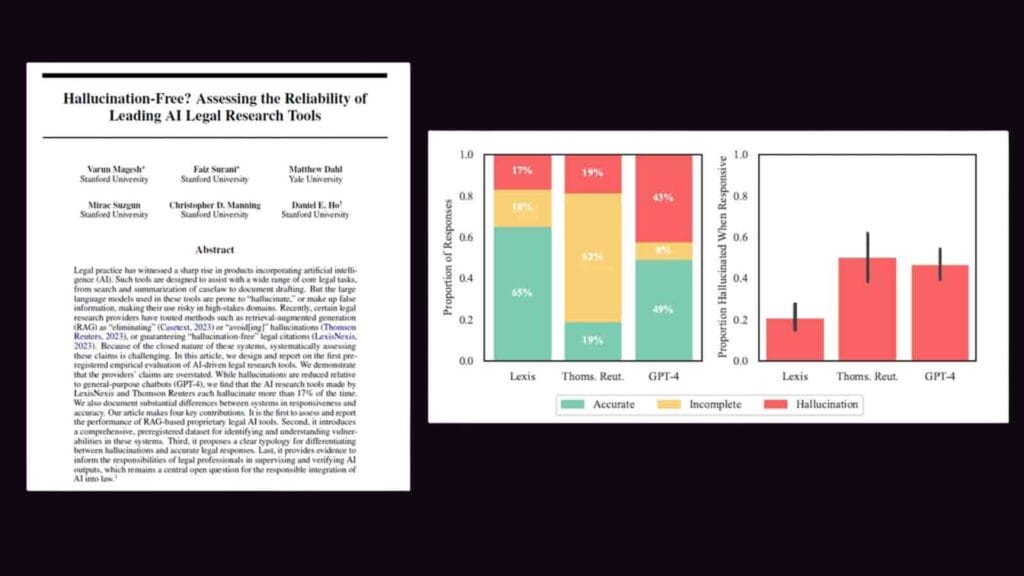
The high-end legal AI tools have been tested recently by Stanford scholars. They tested Lexis+ which is AI based, Westlaw which is AI-Assisted Research, and chatbots in general including ChatGPT using the same legal questions. The Stanford research claims that legal AI continues to be devastating in hallucinating, meaning falsifying information confidentially. Legal queries were failed (between 58 and 82 per cent) by General chatbots.
There were specialized tools, which did better but nevertheless failed often. The technologies offered in these programs employ RAG (Retrieval-Augmented Generation), which is a technology that relates AI to verified databases rather than guesswork. Although RAG will minimize errors, it does not remove them. The authors of the study concluded that there is yet to be a solution to legal hallucinations.
The 1 in 6 Risk Factor of AI in Legal Sectors
The available statistics demonstrate that the likelihood of an error of an expensive, specialized legal AI is 1-in-6. That is to say that about 17 per cent of all AI-generated responses to legal are inaccurate. Take the case of a lawyer with 10 motions made with the aid of these tools. One or two of those filings will include a hallucination statistically. This is a very high failure rate that makes legal drafting a life threatening game of chance.
The Case Study: Promises vs. Reality of AI Mistakes in Law
Retrieval-Augmented Generation (RAG) purports the vendors of technology to resolve the hallucination issue. It is a technology of relating AI with verified databases rather than relying on it to guess. Still, the independent researchers discover that even the special tools do not withstand pressure.
A study at Stanford University in 2024 was able to show that one in every six complex queries continued to hallucinate with the legal AI tools. Models that are general-purpose are also much more deplorable since they tend to miss the right legal standard in more than half of the tasks. Such failures are made due to the fact that the models apply more focus on linguistics patterns rather than actual legal logic.
These tools have problems with hallucination by omission that the Stanford Human-Centered AI researchers think hampers the tools, in which the tools disregard the fundamental, recent case law. In the case of lawyers, even a verified tool can still fail to notice that single case leading to a legal victory, or a loss.
How The Court Responses To AI Failures in Law
Judge Wang has witnessed the deluge of AI filings. She talks of the phenomenon as a digital plague which keeps the integrity of the record at risk. She has ordered all the attorneys to submit a certificate in a recent ruling, whether they used AI in conducting their research or not.
In her order of standing, Judge Wang said: The court is no one on which to test experimental software. She points out that lawyers ought to Shepardize all the results and this implies that they ought to check them with the old legal databases.
A client authorized to speak on behalf of one of the approved attorneys said that it was a nightmare in terms of efficiency. He employed AI to manage a crunching work-load. That machine made a brilliant-sounding short which alluded to a non-existent “Varghese v. The case of China Southern Airlines. The refusal of the court was quick and open. He now cautions fellow Workmen not to be enticed by that speed trap.
Reasons Why AI Errors Might End a Lawyer’s Career?
In the case of a single practitioner, such figures constitute a financial trap. A lawyer with an average of 100 briefs/year has 17 possible mistake documents. That attorney may incur more than 50,000 outlays in fines per year at a per-court-sanction price of 3,000,000. On top of the cash these errors spark bar complaints and malpractice lawsuits that may put an end to a career.
| Feature | Vendor Marketing Claim | Stanford Research Finding |
|---|---|---|
| Accuracy | “Hallucination-free” | 17% error rate in top-tier tools |
| Reliability | “Ready for court filings” | 1 in 6 responses contain errors |
| Search Method | Verified search | Predictive “guessing” of citations |
It is hugely exposed in large firms too. A company employing 50 lawyers to submit at least 5,000 documents annually might have 250 such files with errors introduced by AI. This book of inadvertence solicits system-wide litigation and destroys the image of the firm in the judiciary.
The Marketing vs Reality of AI in Law
Major products such as Thomson Reuters are the biggest marketers of AI as the future of the law. According to David Wong, Chief Product Officer at Thomson Reuters, in the nearest future, not using AI will be part of malpractice. The Stanford independent test however shows that there is a great disparity between the marketing claims and their real actions. Even their own technology displayed some flaws when conducting the independent Stanford trials, even because of the 650 million dollars invested in AI technology.
This trend is similar to a recent study of healthcare AI in Texas. The Texas Attorney General resolved with a company, which stated almost zero error ratio. Those claims were found to be most probable by investigators. This level of similar lack of disclosure applies at present to legal vendors as to how accurate they are actually.
These tools according to BYU Law professor Nick Hafen are prediction engines, as opposed to search engines. They anticipate the way a case citation must appear following some patterns. Therefore, the AI usually tends to make references to nonexistent cases. To maintain their professional status, lawyers have to keep on Shepardizing, or check their results in the personal library of the traditional legal databases.
What Is an AI Hallucination | UNDERSTANDING AI HALLUCINATION
Steven Schwartz is a lawyer who created a motion involving a lawsuit based on personal injury using an LLM (Large Language Model). The AI was so sure of the counterfeit citations on six cases that it presented them as valid precedents. This incident is one of the main examples of AI hallucination, which is the case when AI recklessly invents fake data. In the court order contained in Mata v. Avianca, these imaginary instances did not occur anywhere in real life.
The AI is based on guessing the most probable next word of the sequence. It lays more emphasis on the visual pattern of a legal document instead of on the truth. It gets to understand that the look of legal citations is like this and creates a string of text that fits that form. It invents imaginary choices as opposed to finding real cases. This indicates that an otherwise professional appearing brief can have entire fiction. Lawyers should understand that AI is the imitation of the style of authority in the complete absence of factual knowledge.
In order to know why it occurs, it is best to consider the workings of an LLCM (Large Language Model), which ChatGPT is based on. AI is not a search engine it is a prediction engine. It does not seek facts; it foretells the initial word in a sequence with the help of tendencies.
The Three Kinds of AI Failures in Law
The main researcher Damien Charlotin found that AI has three notable ways of failing in the legal domain.
- Type 1: Complete fabrication
The AI creates a case name and a citation completely out of thin air (e.g., Smith v. Tech Corp, 555 F.3d 123). - Type 2: Fake quotes from real cases
The name of the case is factual, and the quote taken by the AI was never-written in the opinion. - Type 3: Correct citation, wrong legal principle
The reference is accurate, but the AI does not reflect the legal decision in any manner.
This mistakes can be dangerous since citation can be valid on the surface so it is difficult to detect in the process of a general review. Third, the AI has given a right citation and a wrong principle of law. It is real-life, and the AI distorts the decision made by the judge.
Studies conducted by Stanford university showed that popular artificial intelligence models often do not give the correct law reference. Such mistakes are possible due to the fact that the AI is biased towards probability and not verified information. This observation indicates that attorneys cannot use AI as a normal search engine. These errors are never heeded by humans and therefore enter the drafting process undetected.
Such a counterfeit date or statistic would be a small embarrassment in other industries. With law, a bogus reference can cause dismissal of the case and loss of the license of the lawyer. That is why all citations have to be Shepardized-verified with the help of traditional legal databases in order to remain a good law.
Real Life Stories of People Who Suffered Due to AI Failures in Law
Case:1 | AI Failures in Law
The cost of such mistakes is dramatic to clients such as Roberto Mata. His suit was delayed and the validity of his suit could be questioned due to the fact that his legal counsel had provided fraudulent research. According to judge Kevin Castel, it is an unprecedented situation of fake judicial rulings found in a court. Judge Castel says that it is detrimental to use forged citations in the judicial system.
A mistake produced by an AI system in other areas could be a simple nuisance. In the law community, a bogus reference results in penalties and the possible loss of a legal case of a client. The rules of behavior of the lawyers are rules of ethics known as Model Rules. Ceasing all these rules jeopardizes a law license. The court system is based on the truth, and a single sentence perceived as a hallucination can ruin a career.
Case:2 | AI Failures in Law
The technology companies are hardly the victims of such errors. The mother Maria who wanted her child support changed was not allowed to attend her court case due to a fake AI case presented by her pro se opponent. A pro se litigant is a natural representing himself or herself.
The misunderstanding associated with the bogus references led the judge to postpone the hearing by three weeks. Maria was forced to spend more unpaid working time on the rearranged date. I suppose Ms. Law was supposed to be about facts, she thought. The AI has made my life more of a gamble to spot the lie.
This narrative is an example of a systemic risk. Most of the time, ordinary people are the most affected by AI contaminating the legal pool, as those who can afford to have an expensive legal team to examine every single line are the most vulnerable ones.
How the Legal Sector is Handling AI Issues
The legal sector is now changing its CLE issues. The courses introduced are specific to prevent future sanctions and are called AI Literacy. The experts also indicate that the only mode of safe usage of AI is to assume it is a lying junior intern.
A 2025 report published by the American Bar Association states that 4 out of 10 companies now have an internal policy prohibiting the use of unverified AI in generating client-facing documents. These companies must have the human-in-the-loop workflow. No citation can be filed without a human touch being applied to it.
The “So What?” is evident: Technology is a strong helping and a perilous ruling. Decades of work go into the creation of your reputation, but in seconds, a single paragraph treated as a hallucination can be taking away. The only way to safeguard your practice is to get back to the foundations of verification and positive cynicism of automated genius.
How A Lawyer Can Use AI in Law
RAG (Retrieval-Augmented Generation) is the new place lawyers are venturing. It is technology, which links AI to validated databases rather than allowing it to speculate. Despite these types of tools, all attorneys need to Shepardize each outcome. This encompasses checking with the conventional legal databases so as to ascertain whether the law remains intact. Attorneys should also be exposed to CLE (Continuing Legal Education) in order to know these threats posed by technology.
The time wasted in the process of applying AI is lost unless the lawyer is going to lose hours in verifying each and every line. People that represent themselves without a lawyer or attorneys are at the most risk of these mistakes. They do not usually have the costly databases that can be used to triple-verify AI assertions. The appropriate method of verification is the only means of getting the AI to predict the law correctly.
THE EPIDEMIC DATE
In May 2023, law firm attorney Steven Schwartz wrote a brief in a personal injury case with the help of an LLM (Large Language Model). It is documented in the court that research has revealed that he filed six all-faked judicial decisions to a federal court. The legal team was fined by Judge P. Kevin Castel and he ordered a public hearing to deal with the mistake. This happened and presented the population with AI hallucination, involving AI assertively inventing factual misinformation. Lawyers should now learn that AI aligns with legal patterns with no regard to actual facts.
Fall of Major Law Firms due to AI Failures in Law
In 2024 major law firms (such as Morgan and Morgan and K&L Gates) were also hit by AI mistakes by being fined. As judicial records indicate, studies reveal that the Southern District of Florida was a hot destination where seven independent cases were involved with fabricated citations. In Arizona, judges also reported finding six federal filings that consisted of hallucinated contents within the same time. Such errors demonstrate that even professionals working in major law firms cannot handle AI risks on a regular basis. Professional adheres to strict review of their reputation and those of their clients to safeguard their reputation.
At mid-2025, the problem has become a global epidemic. The research conducted in accordance with the global tracking data is that the number of confirmed cases of AI errors in court increased to 712 worldwide. These cases increased dramatically in the United States to almost three cases a day as opposed to the two cases that were experienced per week. Judge Nina Y. Wang authorized the MyPillow legal team in July of 2025 due to their submissions being full of errors. This fast pace of acceleration compels the courts to be hypervigilant and treat all documents assisted by AI with utter suspicion.
The Clients Who Pay The Price Due to AI Errors in Law
Clients greatly lose in cases where their lawyers present delusional research. A judge who finds a bogus citation usually suspends the appearance in order to get the conduct of the lawyer into question. In accordance with exertions in judicial delays, studies indicate that these inquiries add roughly a number of months to the legal procedure. This is a setback to the injured parties as they have to wait longer in compensation to settle the hospital bills. Law writing ought to be accurate to ensure a fast and fair justice system.
Clients are also victimized in financial loss when they overcharge them with the fake work. Oftentimes, the victims are required to incur extra costs to hire new lawyers to correct the initial errors and come up with amended briefs. Secondly, a study provided by client advocacy reveals that the confidence in the legal profession decreases dramatically once an error relating to AI took place. Cases involving fraudulent research also lead to dismissal of a case by a judge leaving some clients without their entire cases. It is the responsibility of lawyers to ensure delivery of honest and factual work.
Systemic Trust and Pro Se Litigants
Self-represented litigants (pro se litigants) have 58 percent of all of the AI-related court errors. Such people will turn to free AI applications, but they are unaware of how to Shepardize, or that is, to verify them in the traditional legal databases. As per the court statistics, it was found that these self-represented parties are instantaneously dismissed when fakes were made in the AI-generated briefs. This poses an enormous impediment to justice to individuals who are unable to buy professional advice. It is necessary to inform people about the limitations of AI by giving clear warnings to support the rights of every citizen.
The Sanctioned Lawyers
In a demonstration of an LLM (Large Language Model)/reliance to write a legal brief, this tool generated an AI hallucination, or in other words a time where AI convincingly fabricates new content that leads to the legal team submitting a total of six faked cases. The lawyers were fined the amount of 5000 dollars by Judge Kevin Castel due to their carelessness and dishonesty.
As Judge Castel agreed, the attorneys had left their duties towards the court and the client. Through this punishment, the lawyers are obliged to inform all the judges whom they falsely referred to, of their professional sanctions.
It was on account of these forgeries that the personal injury case of the client was stalled. He relied on his legal team to conduct proper research so that he can win his suit. Rather, his whole claim was at stake by the inability of the team to Shepardize or check with the old fashioned legal databases. This carelessness contravenes with the Model Rules which are set of rules of ethics under which lawyers conduct themselves.
According to the researcher Damien Charlotin, most attorneys have problems figuring out when an AI is generating fictional content. These errors usually appear the same as legal writing that is legitimate in nature as described by his research. This misunderstanding results in a court order of the general public that forever devastates the reputation of a lawyer in the search engines.
These firms will find it hard to obtain malpractice insurance in future because of high-risk behavior. The attorneys should understand that personal name and license are at stake whenever they employ automated tools.
THE COURT SYSTEM BURDEN
The clerks and judges are now wasting dozens of hours in patenting fiddles of legal filings. Research indicates that hundreds of documented instances exist where legal professionals put in a document consisting of an AI hallucination (when AI is certain to convey an imaginary piece of information). This is a bad issue that involves senior lawyers, expert witnesses and even judges. Such miscalculations compel members of the court to go wild and do not work on real cases as they are forced to confirm non-real cases.
This crisis was dealt with by Chief Justice John Roberts in his annual report. He warned any juridical practitioner to never trust his/her reliance on such errors. This caution points to the fact that the courts might soon make it mandatory in terms of disclosure of the usage of an LLM. More than fifteen federal districts already make attorneys confess about using AI tools with the purpose of providing transparency in the courtroom.
A NEW DUTY EMERGES
In the case of Noland, the attorney did not realize that the opposing party had filed false AI references. The lawyer would come up with fees on the additional time of handling such mistakes later. The court denied the motion since it is the inactive obligation of lawyers to identify inaccuracies in all filings when they arise. This decision alters the practice of the whole legal profession.
THE $10.82 BILLION QUESTION
The Massive Market of AI for Lawyers
Legal technology is attracting record drug amounts in the hands of investors. Research reveals according to Statista that the legal AI market will grow over the next few years to reach over 10.82 billion in 2030, as compared to the current 1.45 billion in 2024. Last year, venture capital firms spent close to $5 billion in these tools, which is a 47-percent increase in venture capital.
This is due to a surge happening in the legal industry that is trillion dollars in size, and the automation of this sector would present a huge monetary payoff. The cost of an LLM (Large Language Model) is a minor price to pay to gain speed, as it is going to be billed at a high rate.
This capital injection transforms the mode of operation of law firms. Judge Kevin Castel believes that, in accordance with research, this is a unique situation that the court has never encountered with the issue of fabricated AI filings. Such investments are a good indication that AI will be here to stay in the law, despite the initial mistakes. In the case of clients, this implies that the legal cost they face would eventually reduce as companies automate costly activities. The reason why investors place bets on this efficiency is that they think that technology will ultimately beat the existing accuracy challenges.
Who is Actually Using AI in Law
Big companies embrace new technology at a far greater rate as compared to small offices. LexisNexis report indicates that 39 percent of large companies utilise AI and only 20 percent of small firms do. The reason behind this gap is the fact that larger companies have the funds to cover CLE in training their employees. Even firms that are in reserve are experimenting by individual lawyers. Generative AI, which is about 31 percent used by attorneys themselves in 2024, has its curiosity steadily increasing among professionals.
Automation is adopted at a faster rate in different areas of practice. Paperwork is also of high volumes, which is why, immigration lawyers are taking the lead in the sector with a 47 per cent adoption rate. Civil litigators in comparison are more restrained with only 27 percent adoption. This warning is based on the fear of an AI hallucination, or when AI endeavors to come up with specific information that is not true with certainty. Any kind of litigation may involve high stakes, and this demands flawless accuracy, which makes most trial lawyers unwilling to place their trust on software.
The ROI Reality Check of AI Usage in Law
The software purchases are becoming on-the-ground cash-generators to firms. The research indicates that 53 percent of companies have a positive payoff on their AI investments (Thomson Reuters). In addition, six out of ten members of the legal profession indicate that their productivity has increased tangibly. These figures confirm that AI assists attorneys to be more efficient in their time usage. It enables the lawyers to be able to put their plans and strategies to complex instead of ordinary routine administrative duties.
The reality of the tasks that are being automated may be unexpected by the viewers. It is found that fifty four percent of lawyers are drafting emails and correspondence using AI rather than conducting research on cases. The remaining 47% of them make use of such tools to analyze financial information on behalf of their clients. The attorneys perform such safe tasks as an avoidance of breaching Model Rules, which are ethics rules that can regulate the behavior of lawyers. They specialize in the administrative tasks without fearing to get a fake case to be submitted before a judge thus becoming more efficient.
The Vendor Arms Race
The legal tech giants have acquired the smaller innovators to establish a monopoly in the market. Thomson Reuters purchased Casetext and its RAG technology for a fee of 650 million. RAG is a kind of technology to tie AI to verifiable databases as opposed to letting it make guesses. This acquisition demonstrates that legal research can be viewed as the future direction of established companies because of AI. Nevertheless, all such tools need human control to avoid expensive errors.
The marketing statements usually outwit the real functionalities of the software. Even highly trained legal AI researchers at Stanford University have found errors in independent testing. Most of the vendors boast that their products are hallucination-free but this can mostly be proved otherwise by studies.
LEGAL | Financial And Professional Implications
The Sanction Spectrum
Attorneys Steven Schwartz and Peter LoDuca were fined by Judge Kevin Castel 5,000 USD because they had presented fake citations which were produced by an LLM (Large Language Model). Based on the court order, studies indicate that the lawyers behaved in a manner of conscious avoidance of the truth of the proceedings. In other states, the fines are even better like the penalty of $10,000 which is given by California Court of Appeals. These penalties present an out and out attack on the profitability and professional status of an organization. This implies that one unauthenticated click may cost an attorney months of revenue.
In addition to money, judges usually disqualify sanctioned attorneys on their cases. This public shaming leaves a record in the career of a lawyer that he or she will live. It has become common in courts to require such people to take CLE (Continuing Legal Education) in AI ethics. This necessitated training so that the practitioners could learn technical constraints that they had not cared about before. As a result, the reputation of a lawyer will be provided as an everlasting caution in Google search.
The Regulatory Scramble of Law Due to AI
In July 2024, the American Bar Association issued a Formal Opinion 512 that set the national standards of AI usage. Research conducted by the ABA indicates that the Model Rules (ethics rules applied to lawyers) stipulate that the law enforcement personnel should be made aware of the dangers posed by novel technology. This implies that a lawyer will have no excuse to say that they were unaware when an AI hallucination or a situation where AI highly believes in inventing false information destroys a filing.
These rules are rapidly being complicated by the state issuers. Early in 2025, Texas, Oregon, and Vermont promulgated their guidelines on court filings and billing. The Texas State bar dictates that a research inquiry has indicated that the lawyers should not bill the clients on the time saved by the AI. This presents a patchwork of challenges in standards to the firms with operations across a number of states. This is non-uniformity, which may see a lawyer be in compliance in one town, and being accused of a grievance in another.
The Insurance Crisis
Protection against automated errors has not changed the many law firms that perform their business without protection in that their policies are not currently equipped. Based on the industry statistics, studies reflect that 91 percent of malpractice insurers do not cover AI errors unless the company purchases a special endorsement. All these riders attract a cost of between 2500 to 15000 each year. Recently, one of the medium sized companies got hit by a colossal claim when their AI could not find a conflict of interest. This financial disparity can also give rise to an event whereby, just one technical mistake can cause complete bankruptcy of a firm
This has seen insurers reward those firms that have strong human-in-the-loop measures. In market research, it is stated that companies that have written AI policies have 76 fewer complaints on ethics. These companies frequently give out the high-value offers of up to 10 per cent to certify that they Shepardize (check with the antique legal databanks) each reference. This reward program encourages the lawyers to be more accurate rather than quick. Regular validation is useful in ensuring that the insurance of the firm is valid and also protecting the legal rights of the client.
Professional Guidance: From Caution to Codification
Immediate Actions
Attorneys are expected to go through all briefs presented immediately with the assistance of an LLM (Large Language Model). Legal ethics scholar Stephen Gillers has conducted legal research to determine that lawyers are still accountable to each word they present to a court. We have to check each of the citations according to conventional law databases to be sure that they are correct. Consulting ethics counsel immediately is required in the case of an AI hallucination, which is where AI is certain about creating false information.
Instead of conducting real research, only brainstorming with general AI tools should begin today. You need to consider every output of AI as a depth superficial draft which needs thorough human editing. Recording your verification exercise safeguards your career. A lawyer was fined a sum of $5,000 due to the fact that he did not scrutinize the work of the AI beforehand. This is a mere measure that would help you avoid such monetary fines and maintain your image to the judge.
Verification Protocol
Use a rigid three step procedure regarding citing. Checking that the case exists is to search a paid database using the name of the case and case number. Second, find the exact quote in the entire opinion to be sure that the AI was not a forger of the quote. Third, read it through once as it is important to ensure that in fact the case has your side in your legal argument. In a study conducted by Stanford University, researchers discovered that the existing AI models give incorrect legal details on the questions of almost a quarter.
You can find some software such as Clearbrief to create an audit trail of citations. You should also Shepardize all the outcomes which implies you checking on the traditional legal databases whether the law still remains. This procedure occupies an average of five minutes per reference. Although reviewing a brief that contains twenty citations takes an hour and thirty-five minutes of additional work, this reduction is worth defeating a malpractice claim. Verifying is a sure way of making sure that the case of your client is founded on legal principles.
Firm-Level Policies
To regulate the use of these tools by its personnel, law firms will have to define a written AI policy. This policy must provide a list of acceptable software as well as make CLE (Continuing Legal Education) obligatory training of lawyers. American Bar Association research reveals that minimizing the chances of committing an ethical violation occurs when there are guidelines in place. The output of every piece of AI-aided work gathered by junior staff or paralegals have to be revised by senior lawyers. This supervision system will make sure that the firm fulfills its professional requirements as per the Model Rules.
Openness to clients is also a serious issue in a safe practice. You ought to tell your clients when your company applies AI and the way you ensure that it has been verified. AI-generated time must never be charged as human labor staff time. The training programs also should comprise a practical exercise on recognizing the fake cases. Such systems establish a culture of accountability. The company-wide norms defend all employees against the risks of automatization faults.
Red Flags to Watch For AI Use in Law
AI generated text has certain warning signs to watch out for. When the format of the citing kind of report appears slightly strange or the jurisdiction of the court appears possible, chances exist that such a citation is fake. The quotes you should be wary of are those which suit your argument too well or instances of the past year or so which you had never heard of. In case the AI generates the full brief within several seconds, the delivery must be reviewed with a sharp eye.
Horrific Future of AI Usage and Mistakes in Law
Is it possible to end AI Hallucinations in Law?
RAG (Retrieval-Augmented Generation) is a development being made by engineers in order to correct such mistakes. The given technology links AI to verified databases rather than allowing it to make assumptions. Based on new technical examinations, such sophisticated systems demonstrate 90 percent decrease in false claims with reference to the usual models. Despite these improvements, Stanford scientists came to a conclusion that legal hallucinations are a problem that has not been solved yet. Word prediction is still used by AI, and nobody can make any guarantees regarding a 100 percent accuracy of this method. Such a continuous risk implies that the last check is under human control.
Upcoming Regulatory Guidelines For AI Usage in Law
Legal changes are on the rise with 91 percent of state bars coming up with guidelines on the use of AI. Courts in the country have come up with the need to have the lawyer state when he is using them in his filings. The model rules provide rules that every lawyer must observe in order to abide by the ethics rules of conduct. Numerous jurisdictions are soon to be subject to CLE (Continuing Legal Education) that is specifically devoted to AI ethics. These regulations safeguard the citizens against robots. There is a high likelihood that national standards will be created to provide a standard of all courtrooms.
The Competitive Pressure Paradox
The legal firms are in a dilemma of being efficient and safe. Reports by the industry show that 84 percent of large companies intend to spend more on AI in 2025. These companies are experiencing a prospective 23 percent earnings gain through automating often performed duties. According to David Wong of Thomson Reuters, the refusal to apply AI will some day come to be viewed as malpractice. Nevertheless, premature adoption poses the possibility of important liability and increases the insurance premium. Companies need to strike a balance between their profit ambition and the wish not to face sanctions that can destroy the company reputation.
The Future of Hybridity and The New Problems
The emerging issues include fake evidence by deepface and discriminative AI, which might destroy lives. Bad legal advice victims frequently find it difficult to know who is to blame the software vendor or the lawyer. As explained in the Vals AI benchmark, machines have become equally accurate as humans in performing particular administrative tasks. Although this has been achieved, human beings still need to make a conclusive analysis on more intricate aspects within the legal framework.
The most suggestive future is the one, which involves the use of AI pattern recognition with human control. The hybrid model is such that the technology does not replace the need for professional responsibility of law but rather helps them
The Effects of AI Mistakes in Law
Mark DeMaster and Thomas Kachouroff attorneys are now fined with a penalty of 3,000 dollars and have been recognized nationwide on their law practice errors. The case they were working with on MyPillow led to sanctions, after they filed a brief containing a fictional research. This result is indicative of the fact that the confidence levels of an AI are in very few instances equivalent to its real accuracy. These attorneys have turned out to become a permanent caution in a mounting list of legal technology meltdowns.
Researchers monitoring such trends assert that there are currently over 712 cases of AI hallucinations (when AI vests opinions as true and composes false facts) in court filings all over the world.
The Reality of the Tech Gap
Legal AI industry will have a valuation of 10.82 billion despite the high technological challenges in 2030. Based on a study at Stanford university, even legal tools, which are specialized in their use, often give wrong data. These are findings that are contrary to the marketing information of vendors that hallucinate no longer. The latest statistics reveal that sanctions that are awarded to such lapses by judges common to lawyers are in the range of 1,000 to more than 10,000. This investment risk presents a colossal dilemma to companies who attempt to save time.
To be safe, the time of verification with an LLM (Large Language Model) is the same as that of conventional research.
The Measures Lawyers Need To Follow
All the legal practitioners have to be able to institute stringent verification measures. To defend against license suspension, you must be able to take a CLE (Continuing Legal Education) on AI ethics. And to fully comply with the ethics rules that make lawyer behavior in companies, firms need to revise their internal policies to include lawyer conduct Model Rules. It is an important task to ensure the gaps in your malpractice insurance to be covered as a part of handling liability.
In case you have used AI before, check your past filings and make sure that all the citations are valid. And you have to verify by traditional legal databases or by Shepardizing each and every case name before you submit it.
The Future of the Industry
The legal tech industry needs to discontinue absolute claims related to accuracy and offer transparent metrics instead. The developers are required to invest in independent testing to demonstrate that their devices are as they are claimed.
