

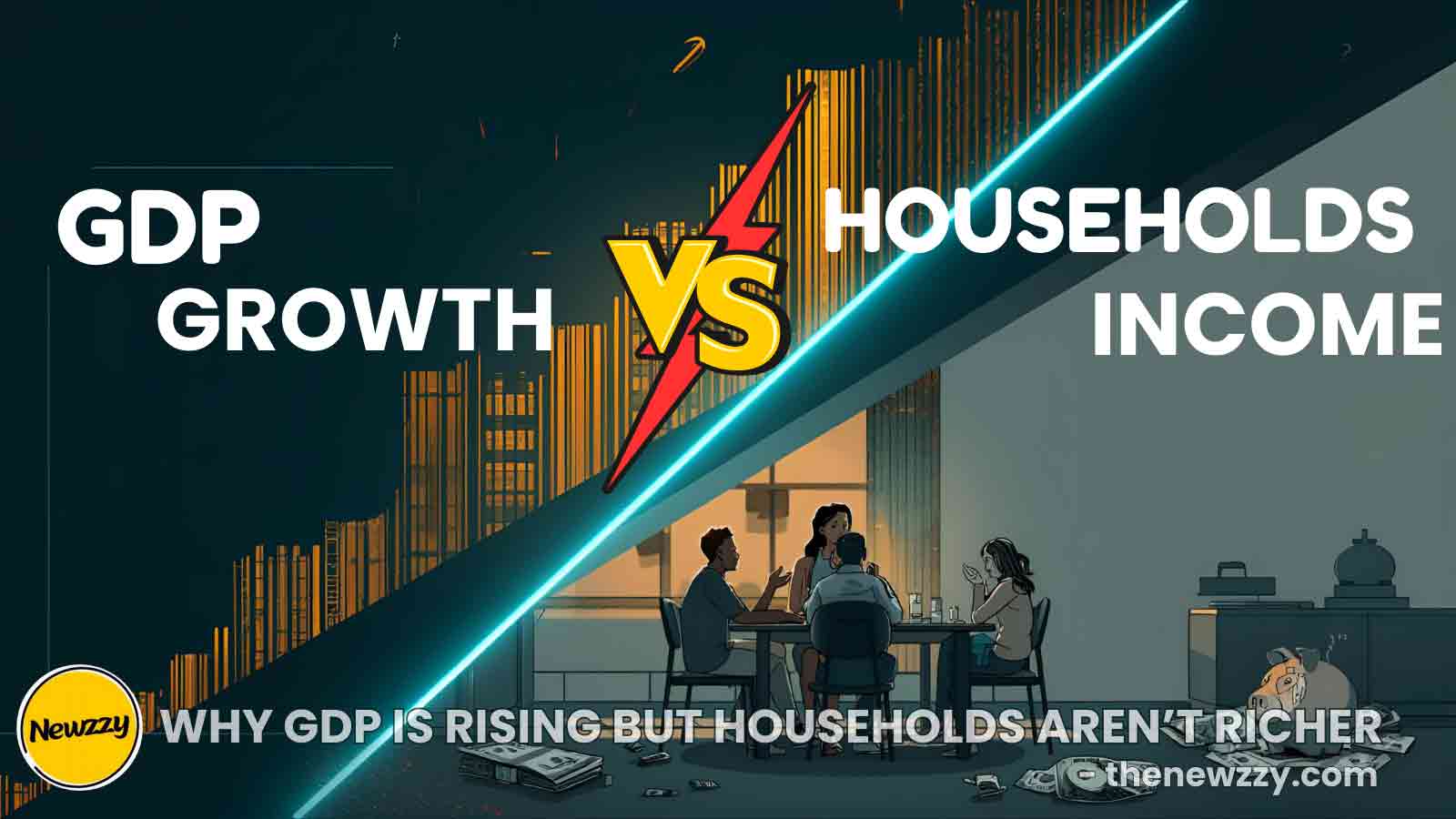
Discover the difference between GDP Nominal vs PPP Purchasing Power Parity. It has become a common event where people glorify increasing Gross Domestic Product (GDP) as an ultimate triumph by a country. Nevertheless, there is a detachment between these macroeconomic factors and reality on the ground, as lived by the average consumer. Such an existence is a result of this gap that GDP represents the scale of engines of a particular economy whereas purchasing power represents the fuel in the tank of a household. The mechanism behind the possibility of the boom economy existing with a feeling of financial strain thus requires one to look into how we measure growth and how we feel value.
Table of Contents
What is GDP?
Gross Domestic Product is used to portray the total monetary amount of all the finished goods and services generated in the borders of a country at a particular point of time. It is a professional indicator of industry and business. People tend to dwell on an increase in the GDP as a straightforward representation of the welfare of the society, or personal financial standing. It is a misguided understanding of the purpose of the metric.
GDP is the number of money flowing through a system. It captures all expenditure on new auto, an attorney fee or an infrastructure undertaken by the government. It fails to consider the quality of life that is to be developed out of that spending. It also does not differentiate between the good and defensive spending as the education investment and the rebuilding efforts in the case of a natural disaster. To GDP, major hurricane is an economic stimulus due to construction and insurance that follows.
Four Pillars of the GDP Equation | What is Included in GDP
GDP can be calculated by summing up four different classes of expenditures, which are computed by economists. The pillars are a representation of each sector of the economy, however, none of them implicitly describes how affordable ordinary life is to the average citizen.
1) Personal Consumption
This consists of the entire household expenditure. Although this has been the biggest part of most of the modern economies, it would be the aggregate amount of expenditure and not the utility acquired. When a family increases the amount of money it is spending on electricity due to the doubling of the rates, there will be an increase in GDP, despite the fact that the standard of living in the family has not progressed or decreased.
2) Private Investment
This includes business expenditure in capital goods including machines, programs and plants. A high investment is an indication of future growth. Nevertheless, the investments involved tend to be oriented to automation or efficiency, which can result in the decrease in the necessity of labor and wage growth inhibition in the long term.
3) Government Spending
The total output is made up of public spending on infrastructure, defense and social services. These amounts reflect the price of service delivery rather than efficiency of the results. GDP may be inflated by high government expenditure sets of expenditure even though the government services provided may be inefficient.
4) Net Exports
The calculation is completed by calculating the balance of trade which is exports and imports. Balance of trade contributes to the GDP, or the wealth that flows into the country. It is subtracted by a trade deficit. This measure demonstrates the position of a given country in the world market but tells very little about how such wealth is shared by the population.
The Invisible Factors Included in GDP
The purchasing power is the quantity of commodities or services that can be purchased using a given unit of money. It is the real indicator of consumer value. GDP omits a number of factors that are critical in assessing a person as rich or poor.
The Taxation of Compulsory Costs
According to GDP, all expenditure is the same. The truth of the matter is that the financial health of a household is determined by what they can afford to spend out of their obligatory expenses. There has been a rapid increase in the cost of housing, healthcare and education as opposed to the general prices in most developed countries. Once these necessities take a bigger portion of a salary, shopping power of a buyer decreases, despite an increase in national GDP.
Household Debt Servicing
Economic output considers the expenditure which is financed by debt without banks taking into consideration the cost of the debt in the long-term. There is the colossal loss of consumer value through interest payment of mortgages, student loans and credit cards. With an increase in interest rates, the servicing cost of this debt goes up and with less money to spend on distinctiveness. GDP still reflects the interest payments as an output in the financial sector effectively quantifying the financial burden of the household as a financial gain.
Regional Price Disparities
National GDPs give one number that is a homogenous number of a given country. These conceal the very large discrepancies between various cost of living in the regions. A high output urban center can be a huge contributor of GDP and at the same time be of huge cost of rent and services that the inhabitants of the area can purchase less compared to another rural location.
The Growing Disparity Between Pay and Expenses in GDP
The largest contributor to the lack of connection between the growth and value is the shift in income growth relative to the price of the necessities.
Difference Between Asset Inflation and Wage Inflation
In most economies, assets, including real estate and stocks, value has increased significantly at a faster rate than the price of labor. These increases in asset prices are reflected in the activity of GDP. But to a young worker or a renter, it is a wealth obstacle due to inflation of assets. The increase in housing prices develops GDP by way of construction and commissions and also by devastating the purchasing ability of the common earner.
Deterministic vs. Stochastic Cost Growth in GDP
Globalization has tended to leave the cost of such discretionary goods such as electronics and clothing steady or lower. On the other hand, some of these costs, such as childcare and insurance are fixed or sticky, which have boomed. These categories are aggregated in GDP. This falsely presents the image of affordability on a statistical level; a buyer can afford a TV at a cheaper price than ever, but he or she cannot afford to stay in the hospital, or to attend college.
Why GDP Growth Fails to Increase Household Income?
The structural causes that make the rise of national output not necessarily lead to the improved life of the individual are there.
Concentration of Profits
The contribution of corporate profits in the modern economy has a large share in GDP growth as opposed to wages. As productivity goes up, the increased it can be allocated to the shareholders as dividends and buyback or to the employees as an increase. In the past few decades, this tendency has been greatly capitalistic as compared to labor. The result of this is a growth in GDP because companies become more profitable but the purchasing power of the average worker does not increase.
Capital-Heavy Growth
Most of the time, capital-intensive growth arises due to technological advancement. When a software company is able to make billions of money and only a handful of hundreds of employees, the contribution to the GDP is enormous. But the trickle down effect on the overall labour market is negligible. Such kind of expansion leads to a winner-takes-all game in which the national economy appears healthy on a paper, yet employment sector is still unstable in the hands of most people.
The Service Sector Inflation Trap
With the maturity of the economies, the focus shifts towards service instead of manufacturing. The productivity cannot be gained the same way in services as in manufacturing, including education and healthcare. It is not an easy task to automate a car assembly line and not to automate a surgeon or a teacher. Consequently, the prices of such services increase in comparison to the other commodities. The fact that they are necessities makes them eat up the wallet of the consumer despite the surge in the GDP.
Why GDP Per Capita Lies to You?
GDP per capita is commonly employed by the economists in order to approximate the individual experience. This is a sharing of the total production to the population. Although this is a better improvement it still has a lot of distortions.
The Skew of High Earners
GDP per capita is not a median, but an average. The large number of high-net-worth individuals can significantly increases the per capita number in a country with extreme income inequality. This will occur even when there is growth of GDP per capita in the case of the top 1% population increases incomes by 20 percent and the bottom 90 percent population decreases incomes by 1 percent. This is a statistical mirage of good times that is not actually there among the average citizen.
Distribution distortion of income
GDP increase of a country may occur in the forms of the luxury consumption of high end or huge-scale company investments in them which do not help the common man to purchase groceries or pay rent. Devoid of a distribution adjustment, GDP per capita will be a gauge of potential resource as opposed to the realized resource to the population.
Alternative Metrics: A Better Vision
The growing interest in alternative indicators by economists and policymakers is aimed at bridging the gap between the output and the value.
What is Purchasing Power Parity (PPP)?
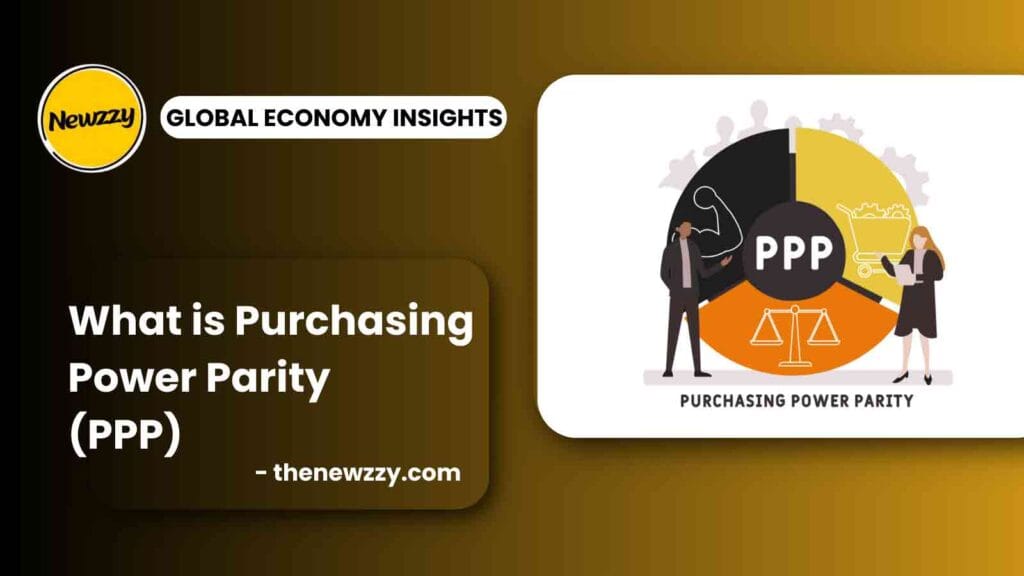
PPP equalizes the price of money to take into consideration the various prices of commodities in various nations. It also enables a more “apples to apples” comparison of what a human is capable of actually purchasing. A low GDP nation with cheap cost of living can possibly present better life than an country with high GDP and astronomical cost of living.
Real Disposable Income
It is an indicator that measures the amount of money available to households after taxes and adjustment against inflation. It is much closer to the consumer sentiment that GDP. The consumers experience the benefits of the economy when the actual disposable income is on the increase. Its stagnation, even after growth in the GDP, indicates that achievement of growth is taken by taxes, inflation or debt.
Median Household Income
In comparison with the average representing GDP per capita, the median is the precise center of the population. It is the straightest peep into what the average family makes. Technically, when median income growth is compared to the rise in GDP, it is seen that precisely such amount of prosperity of a nation is trickling down to the citizens.
Human Development Index (HDI)
The HDI is a combination of economic data and life expectancy and education. There are also some constrained sides to it, namely the deficiency of emphasis on environmental sustainability, but money is not the only part of the value. It has a more holistic perception on whether a country is indeed moving on.
GDP vs Purchasing Power Parity (PPP) | GDP Nominal vs PPP
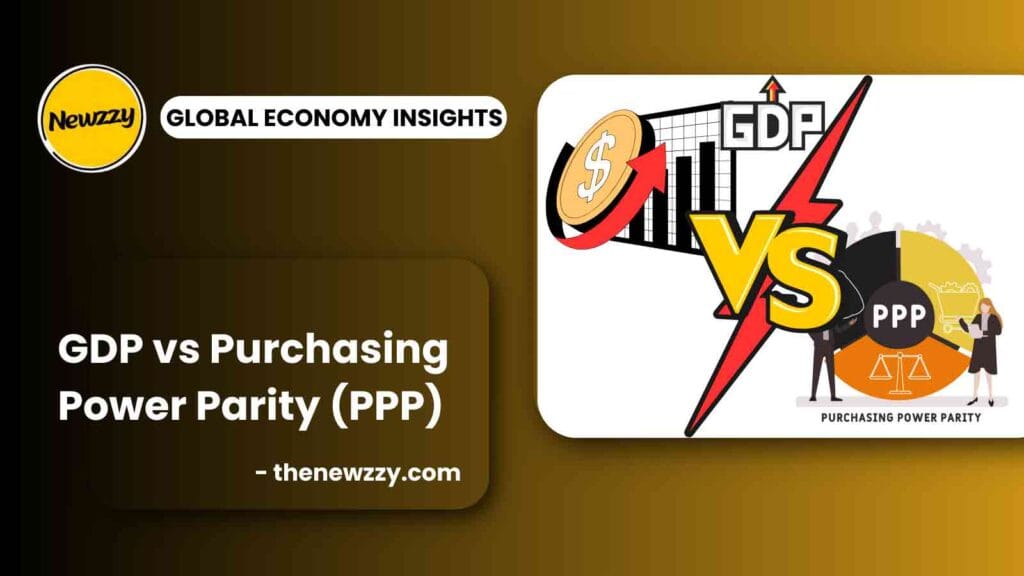
Whole country differences in the organization of the economy result in enormous variations in the relationship between the GDP and the purchasing power.
There are countries that focus on high producing low-regulation environments. Such nations tend to have impressive GDP growth and they dominate the world with regard to innovation and corporate profits. Nevertheless, they also often suffer the expensive price of basic services. Within these systems, the consumer is able to access a high number of goods but is burdened with a lot of personal financial burden in regard to healthcare and education.
Other countries are interested in moderate growth, which is highly socially stable. On paper these economies can indicate lower rates of growth of GDP. Nevertheless, due to the fact that they fund fundamental services using taxation, their citizens are cushioned whilst buying the basic needs out-of-pocket. When this happens, the fact that the GDP was low does not imply that a poor consumer.
These variations underscore the fact that the GDP growth is a policy decision. A country may opt to maximize the total production or maximize the purchasing power and stability of households. These two objectives are not necessarily harmonized.
Why GDP Remains the Standard Economic Metric?
Although its shortcomings have been sufficiently documented, GDP continues to remain as the main economic indicator in a number of practical considerations.
Comparability and Standardization.
The standardized international framework is of GDP calculation. This enables investors and governments to make comparisons regarding the size of economy and health of various countries with a lot of consistency. The global financial markets would not have worked without this shared language.
Policy Convenience
GDP is a hard number that is comparatively simple to follow every quarter. It offers a definite but limited target to the policy-makers. Most government activities including the debt-to-GDP ratios depend on this measure. To have a chance of altering the leading metric, it would entail a colossal reformation of the international law and financial regulation.
Historical Inertia
GDP has been in use in the world since after the post World War II period. The years of data to consider are decades long, and there is the possibility of long-term trend analysis. Even when they may agree that the metric does not reflect well in modern times, economic historians are unwilling to forego a measure with such a rich historical background.
The Proper Use of GDP Per Capita
GDP is a crucial instrument to some activities and a bad instrument to others. It should be used to:
- Determine the overall productivity of a country.
- Compare the performance of industrial and service sectors.
- Establish the capacity of a country to service her sovereign debt.
- Compare the economic strength of the competing nations.
- GDP should not be used to:
- Determine the financial stability of the typical family.
- Establish the price of a house or a medical facility.
- Happiness or well being of a society.
- Evaluate the long term economic practice sustainability.
Conclusion
However, Gross Domestic Product is still the strongest indicator of national economic activity in the history of the world. It has been able to monitor the flow of trillions of dollars all around the world. Nevertheless, it is not a complete story. The potential of a nation is based on its economic output, whereas the reality of the people is the purchasing power.
When the consumer is suffering, and GDP is increasing, it is an indication that the distribution processes, in the form of wages, costs, and tax, do not match. In order to know how healthy a country is in real sense, we have to dig deeper and see what is the balance of value left over by the growth statistics and into the hands of the people. The real economic prosperity does not lie in the capacity to produce more of something but in the capacity to make production to be changed to a stable, affordable and quality life amongst the citizenry.
